

Roland JV-2080 Editor & Librarian
Coming soon · €24.00 launch price
A visual patch editor and librarian for the Roland JV-2080: work with four Tones, envelopes, modulation and effects, then organise your patches from one computer interface.
Expected release: early November 2026.
24,00 € incl. VAT

See how your JV patch is built
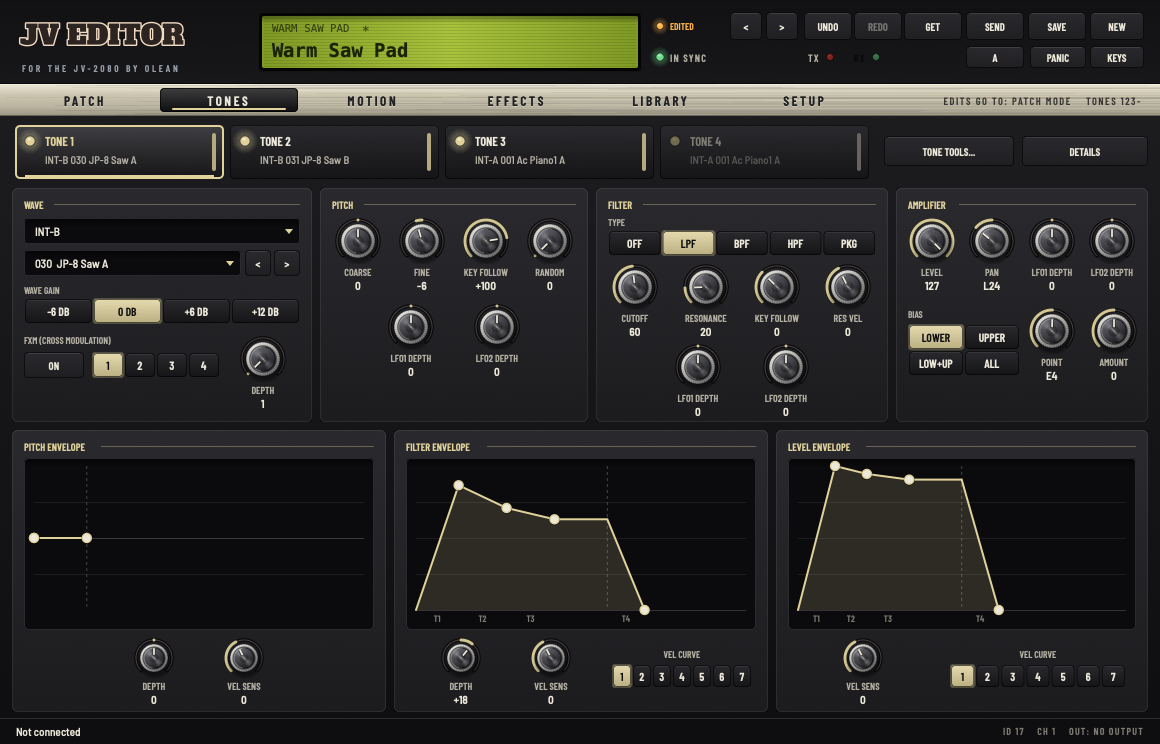
A JV-2080 patch can combine four Tones, paired structures, several envelopes and a substantial effects section. The editor turns those layers into selectable Tone cards, with wave, pitch, filter and amplifier controls grouped together. Draggable envelope displays help you see the shape you are editing instead of reading one value at a time from the rack display.
The editor focuses on patch editing and library work. Full Performance, Rhythm and System editing is outside its current scope.
Inside the current editor
- Patch controls: name, category, level/pan, playing mode, portamento and paired-Tone structures with a signal-flow display.
- Four-Tone editing: internal wave names, expansion-wave selection by number, pitch/filter/amplifier controls and draggable pitch, filter and level envelopes.
- Motion: two LFOs per Tone, controller destinations, keyboard/velocity ranges, Tone delay and performance-related patch switches.
- Effects: EFX, chorus, reverb/delay and Tone output/send controls. EFX parameter controls currently use raw values rather than descriptive parameter names.
- Sound tools: Random, Mutate and Init, Tone copy/swap/solo, undo/redo and A/B comparison.
- Librarian: categories, tags, favourites and notes; .syx patch/bank import/export; a 128-slot USER-memory view with guarded writes.
- MIDI and projects: Roland SysEx receive/send handling, direct or host routing, automation and saved editor state.
Hardware, formats and requirements
The intended instrument is the Roland JV-2080. JV-1080 support is not confirmed.
Planned macOS formats: VST3, Audio Unit and Standalone for Apple Silicon and Intel. A Windows release is not confirmed. Final supported OS versions and DAW compatibility will be listed before launch.
Connect a MIDI interface to the JV MIDI IN and MIDI OUT, match the Device ID and enable Rx Sys.Excl. Tx Edit Data is needed to receive front-panel edits. The editor can target the Patch edit buffer or a selected melodic Performance part; this is patch targeting, not a complete Performance editor. Audio still comes from the JV’s physical outputs.
What it is and isn’t
This is a MIDI editor for the rack hardware, not a software JV sound engine or a collection of Roland waveforms. Expansion selection requires the relevant physical board; the editor does not supply it.
Normal sound edits use an edit buffer. Writing stored USER patches is a separate guarded operation that requires Allow writing and the appropriate hardware memory-protect setting. Full Performance, Rhythm and System editing is not implemented in this phase.
JV-2080 editor FAQ
Will this work with my JV-1080?
That support is not confirmed. The current draft covers the JV-2080 only; any shared-model release needs its own compatibility check.
Can I edit a sound inside a Performance?
The current setup can direct patch edits to a selected melodic Performance part. Editing the whole Performance or Rhythm setup is outside this first phase.
Are expansion-board wave names included?
Internal waves have names. Expansion waves currently use board/wave numbers and require the board to be installed in the hardware.
Can it back up the USER bank?
A USER-memory view and .syx bank tools are implemented. Actual bank transfer and stored-memory writes still need the real JV-2080 validation pass.
Support and independent development
Contact info@oleanshouse.com with your JV setup questions. Browse the Olean’s House synth editors for available tools.
Independent software by Olean’s House for Roland JV-2080 hardware. Not affiliated with, endorsed by or officially supported by Roland. Roland and JV model names are used descriptively to identify the intended hardware.